Thursday, July 29, 2010

Has Obama's "Race to the Top" Lost its Shine?

Fox News (07-29-10) / Pat Summers


President Obama’s $4 billion education initiative to spur school reform has become a veritable piƱata as the program heads into its second round. Not only has Congress raided the account to pay for teacher layoffs to be averted, prompting a White House veto threat of the war supplemental to which it’s attached, but there’s a quiet rebellion going on by some in the education community to ditch the program.


So why has the contest lost some of its shine? According to the ranking member on the House Education and Labor Committee, it’s a loss of confidence in the system.


“Competition is generally a good thing,” says Minnesota Republican Representative John Kline. “The question is fair, whose doing the judging? How’s the point system put together? Let’s face it, in anything like this where you have judges,  whether it’s an Olympic diving competition or something like this, you have some subjectivity. In your state you would like to know what the rules are and want as little subjectivity as possible.”


Minnesota recently joined eight other states in opting out the second round of the contest.
Race to the Top’s aim is to prepare students for a better future. States participate by competing for a federal grant, administered in phases, and fulfilling what the program calls the four assurances: instituting rigorous standards and assessments, recruiting and retaining effective teachers, turning around low-performance schools and establishing data systems to track student achievement and teacher performance.


Phase I winners were announced on March 29th, and the deadline for submitting Phase II applications was June 1st. The winners for this phase will be announced later in September.
The $4.35 billion dollar incentive program was designed by the United States Department of Education and is funded by the ED Recovery Act as part of the American Recovery Act of 2009. It was announced by President Obama and Secretary of Education Arne Duncan on July 24, 2009.


The National Education Association, the largest labor union in the U.S. representing teachers and other support personnel, gave the program a vote of “no confidence” earlier this month. Many saw it as a symbolic slam on the Obama administration. The item would eventually pass, but only by a razor-thin margin.


One member at the NEA convention where the resolution was approved actually offered a resolution to call for the ouster of Secretary Duncan, in part because of the program. That resolution was never approved.


Randi Weingarten, president of the American Teachers Union, called the program a mixed bag. “The real issue is that ‘Race to the Top’ in principle would be a good program if we didn’t have the kind of budget shortfalls that we have right now. It’s hard to be innovative and to do new and different things that require time and resources when we’re seeing state after state having devastating budget cuts.”
But that hasn't stopped several states, 35 of them in fact, plus the district of Columbia, from lining up for a slice of the grant money.


Representative Jared Polis, D-Co., told Fox News, "For every dollar they spend they're getting reforms all across the country. Reforms that encourage good teachers to stay in teaching. Reforms that intervene in changing schools, removing caps for the number of charter schools. These are all things that are happening nationally because of 'Race to the Top.'"


Bottom line – has this contest overstayed its welcome, particularly in the face of rising deficits? Or should Congress reinstate funding and add even more money than President Obama is seeking?
Fox News' Trish Turner contributed to this report.

Friday, July 23, 2010

Jobless In Cuba? Communism Faces The Unthinkable!


FROM (AP)  HAVANA (AP) - At a state project to refurbish a decaying building in Old Havana, one worker paints a wall white while two others watch. A fourth sleeps in a wheelbarrow positioned in a sliver of shade nearby and two more smoke and chat on the curb.


President Raul Castro has startled the nation lately by saying about one in five Cuban workers may be redundant. At the work site on Obispo street, those numbers run in reverse.


It's a common sight in communist Cuba. Here, nearly everyone works for the state and

official unemployment is minuscule, but pay is so low that Cubans like to joke that "the state pretends to pay us and we pretend to work."


Now, facing a severe budget deficit, the government has hinted at restructuring or trimming its bloated work force. Such talk is causing tension, however, in a country where the words "neoliberal job cuts" are sacrilege and guaranteed employment was a building block of the 1959 revolution that swept Fidel Castro to power.


Details are sketchy on how and when such pruning would take place. Still, acknowledgment that cuts are needed has come from Raul Castro himself.


"We know that there are hundreds of thousands of unnecessary workers on the budget and labor books, and some analysts calculate that the excess of jobs has surpassed 1 million," said Castro, who replaced his ailing brother Fidel as president nearly four years ago. Cuba's work force totals 5.1 million, in a population of 11.2 million.


In his nationally televised speech in April, Castro also had harsh words for those who do little to deserve their salaries.


"Without people feeling the need to work to make a living, sheltered by state regulations that are excessively paternalistic and irrational, we will never stimulate a love for work," he said.


Indeed, the process of labor reform may already have started, albeit slowly.


Workers in the tourism sector say some of their colleagues have been furloughed during the lean summer months, while others have been reassigned to jobs on state-run farms.


"Since we are now in the low season, the hotel where I work has sent many workers home for two or three months," said Orlando, a chef in Varadero, a sand-and-surf enclave east of Havana.


"It's very hard because you're left with no salary at all," said Orlando, who like almost all state employees, didn't want his full name used to prevent problems at work. Unemployment benefits don't exist in Cuba. He added, "I'm lucky since I'm still in my job."


Veronica, a receptionist at another Varadero hotel, said she feared she may be sent home in August, when her resort will be only half-occupied.


"Sometimes they offer alternatives, to study in a particular course or another job," she said, "but sometimes, when (workers) are sent into the agricultural sector for instance, they just quit."


With the government giving no details of its thinking, rumors have spread that as many as a fourth of all government workers in some industries could lose their jobs or be moved to farming or construction. But Labor Minister Margarita Gonzalez has promised that "Cuba will not employ massive firings in a manner similar to neoliberal cutbacks."


The government has moved to embrace some small free-market reforms. It handed some barbershops over to employees, allowing them to set their own prices but making them pay rent and buy their own supplies. Authorities have also approved more licenses for private taxis while getting tough on unlicensed ones.


The global financial crisis, and the $10 billion in damage inflicted by three hurricanes in 2008, have forced authorities to run a deficit of 5 percent of GDP, leaving them unable to pay back credits received from China and elsewhere.


Cuba slashed spending on importing food and other basics by 34 percent to $9.6 billion in 2009, from $12.7 billion the previous year. But so far, the moves have not been enough to rein in the deficit.


Carmelo Mesa-Lago, a Cuba economics expert and professor emeritus at the University of Pittsburgh, said Cuban officials have spent months debating cuts in the labor force and economic reforms. He said they know what's needed, but face "a problem of political viability."


Various government perks like cars, gas, uniforms and office supplies have become incentives to bloat the payroll, since they are based on the size of a company's work force.


But low pay means low productivity. On Obispo street, a state-run cafeteria sells heavily subsidized soft ice cream and pork sandwiches for the equivalent of a few American pennies - meaning wages and tips are so tiny that the staff is completely indifferent toward customers.


Three waiters sit at the counter cracking jokes. A fourth is the only one working, making coffee for three tables. Nearby, a cashier stares into space, a cook flirts with a scantily clad teen and a supervisor sits idly by.


The state employs 95 percent of the official work force. Unemployment last year was 1.7 percent and hasn't risen above 3 percent in eight years - but that ignores thousands of Cubans who aren't looking for jobs that pay monthly salaries worth only $20 a month on average.


Salvador Valdes Mesa, secretary-general of the nearly 3 million-strong Cuban Workers Confederation - the only Cuban labor union allowed - has instead written that "reorganization" will ensure redundant workers are reassigned rather than fired.


He said the government wants more jobs in construction and agriculture.


Still, 35-year-old computer engineer Norberto fears for his job. He thinks it's unfair to keep workers under communist domination and yet call them unmotivated. "I didn't graduate from college to now work as a day laborer or a peasant, he said.


If he loses his job and gets an offer to work abroad, he said, "my question is 'Will the Cuban authorities put aside their paternalism and let me leave?'"

-

-

-

-

-

-

-

-

-

-

-

-

-

-

-

-

MailitUSA

Yellow Cards

Accurate Mailing Service

Accurate Mailing Services, Inc.

Speaking Of That-

Saturday, July 17, 2010

Only 23% Say U.S. Government Has the Consent of the Governed

The notion that governments derive their only just authority from the consent of the governed is a foundational principle of the American experiment.


However, a new Rasmussen Reports national telephone survey finds that just 23% of voters nationwide believe the federal government today has the consent of the governed. Sixty-two percent (62%) say it does not, and 15% are not sure.


These figures have barely budged since February.


There is no gender gap on this question. Younger voters are more likely than their elders to believe the government today has the necessary consent. Among voters under 30, 28% say the government has that consent. Just 15% of senior citizens share that view.


From an ideological perspective, most liberal voters (58%) think the federal government has the consent of the governed. Most moderates (57%) and most conservatives (84%) disagree.


Democrats are closely divided on the question. Republicans and unaffiliated voters strongly reject the notion that the government has the consent of the governed. 

(Want a free daily e-mail update? If it's in the news, it's in our polls).  Rasmussen Reports updates are also available on Twitter or Facebook.


The survey of 1,000 Likely Voters was conducted on July 12-13, 2010 by Rasmussen Reports. The margin of sampling error is +/- 3 percentage points with a 95% level of confidence. Field work for all Rasmussen Reports surveys is conducted by Pulse Opinion Research, LLC. See methodology.


In his new book, In Search of Self-Governance, Scott Rasmussen observes that the American people are “united in the belief that our political system is broken, that politicians are corrupt and that neither major political party has the answers.” He adds that “the gap between Americans who want to govern themselves and the politicians who want to rule over them may be as big today as the gap between the colonies and England during the 18th century.”


The book earned positive reviews from Larry Sabato, Pat Caddell, Bill Kristol, Joe Trippi and others. In Search of Self-Governance is available from Rasmussen Reports and at Amazon.com.

Data released yesterday finds that 68% of voters believe the Political Class doesn’t care what most Americans think.  Earlier polling shows that 59% are embarrassed by the behavior of the Political Class.


Rasmussen Reports has documented the wide gap between perceptions of the Political Class and Mainstream voters. To measure this gap, the firm has created a Political Class Index based upon three polling questions.   Mainstream voters tend to trust the wisdom of the crowd more than the wisdom of politicians and are skeptical of the government and its relationship with big business.

Not surprisingly, only four percent (4%) of Mainstream Voters think the Political Class cares.


Over the past couple of years, most Americans have opposed many initiatives of the Political Class including the bailouts of the financial and auto industries. Additionally, most voters still favor repeal of the national health care plan and overwhelmingly disagree with the Justice Department's decision to challenge Arizona's new immigration law in court.


Fifty-five percent (55%) don’t even think most members of Congress pay all the taxes they owe.

Voters are evenly divided over the notion that a group of people randomly selected from the phone book could do a better job than the current Congress.


One reason for skepticism about the Political Class is that  70% believe Big Government and Big Business are on the same team  working together against the rest of us.


Please sign up for the Rasmussen Reports daily e-mail update (it's free) or follow us on Twitter or Facebook. Let us keep you up to date with the latest public opinion news.

See survey questions and toplinesCrosstabs are available to Premium Members only.


 Source: Rasmussen Reports 

-

-

-

-

-

-

-

-

-

-

-

-

-

-

-

MailitUSA

Yellow Cards

Accurate Mailing Service

Accurate Mailing Services, Inc.

Speaking Of That-

Friday, July 2, 2010

President Speaks Truth on Illegal Immigration


'In the first place, we should insist that if the immigrant who comes here in good faith becomes an American and assimilates himself to us, he shall be treated on an exact equality with everyone else, for it is an outrage to discriminate against any such man because of creed, or birthplace, or origin. 


But this is predicated upon the person's becoming in every facet an American, and nothing but an American...


There can be no divided allegiance here. Any man who says he is an American, but something else also, isn't an American at all. We have room for but one flag, the American flag... We have room for but one language here, and that is the English language.. And we have room for but one sole loyalty and that is a loyalty to the American people.'


The Story of Independence Day

Independence Day is the national holiday
of the United States of America commemorating the signing of the Declaration of Independence by the Continental Congress on July 4, 1776, in Philadelphia, Pennsylvania
.


At the time of the signing the US consisted of 13 colonies under the rule of England's King George III. There was growing unrest in the colonies concerning the taxes that had to be paid to England. This was commonly referred to as "Taxation without Representation" as the colonists did not have any representation in the English Parliament and had no say in what went on. As the unrest grew in the colonies, King George sent extra troops to help control any rebellion. In 1774 the 13 colonies sent


delegates to Philadelphia Pennsylvania to form the First Continental Congress. The delegates were unhappy with England, but were not yet ready to declare war.


In April 1775 as the King's troops advanced on Concord Massachusetts Paul Revere would sound the alarm that "The British are coming, the British are coming" as he rode his horse through the late night streets.


The battle of Concord and its "shot heard round the world" would mark the unofficial beginning of the colonies war for Independence.


The following May the colonies again sent delegates to the Second Continental Congress. For almost a year the congress tried to work out its differences with England, again without formally declaring war.


By June 1776 their efforts had become hopeless and a committee was formed to compose a formal declaration of independence. Headed by Thomas Jefferson, the committee included John Adams, Benjamin Franklin, Robert R. Livingston and Roger Sherman. Thomas Jefferson was chosen to write the first draft which was presented to the congress on June 28. After various changes a vote was taken late in the afternoon of July 4th. Of the 13 colonies, 9 voted in favor of the Declaration, 2 - Pennsylvania and South Carolina voted No, Delaware undecided and New York abstained.


To make it official John Hancock, President of the Continental Congress, signed the Declaration of Independence. It is said that John Hancock signed his name "with a great flourish" so "King George can read that without spectacles!."


The following day copies of the Declaration were distributed. The first newspaper to print the Declaration was the Pennsylvania Evening Post on July 6, 1776. On July 8th the Declaration had its first public reading in Philadelphia's Independence Square. Twice that day the Declaration was read to cheering crowds and pealing church bells. Even the bell in Independence Hall was rung. The "Province Bell" would later be renamed "Liberty Bell" after its inscription -


Proclaim Liberty Throughout All the Land Unto All the Inhabitants Thereof


And although the signing of the Declaration was not completed until August, the 4th of July has been accepted as the official anniversary of United States independence. The first Independence Day celebration took place the following year - July 4 1777. By the early 1800s the traditions of parades, picnics, and fireworks were established as the way to celebrate America's birthday. And although fireworks have been banned in most places because of their danger, most towns and cities usually have big firework displays for all to see and enjoy.


Source: Independence Day 


-

-

-

-

-

-

-

-

-

-

-

-

-

MailitUSA

Yellow Cards

Accurate Mailing Service

Accurate Mailing Services, Inc.

Speaking Of That

Friday, June 18, 2010

Quote from Mort Zuckerman: World Sees Obama as Incompetent and Amateur

Original text By Mortimer B. Zuckerman
Posted June 18, 2010
The fact is that President Obama came into office as the heir to a great foreign policy legacy enjoyed by every recent U.S. president. Why? Because the United States stands on top of the power ladder, not necessarily as the dominant power, but certainly as the leading one. As such we are the sole nation capable of exercising global leadership on a whole range of international issues from security, trade, and climate to counter-terrorism. We also benefit from the fact that most countries distrust the United States far less than they distrust one another, so we uniquely have the power to build coalitions. As a result, most of the world still looks to Washington for help in their region and protection against potential regional threats.


Click here to find <br />out more!
Yet, the Iraq war lingers; Afghanistan continues to be immersed in an endless cycle of tribalism, corruption, and Islamist resurgence; GuantƔnamo remains open; Iran sees how North Korea toys with Obama and continues its programs to develop nuclear weapons and missiles; Cuba spurns America's offers of a greater opening; and the Palestinians and Israelis find that it is U.S. policy positions that defer serious negotiations, the direct opposite of what the Obama administration hoped for.The reviews of Obama's performance have been disappointing. He has seemed uncomfortable in the role of leading other nations, and often seems to suggest there is nothing special about America's role in the world. The global community was puzzled over the pictures of Obama bowing to some of the world's leaders and surprised by his gratuitous criticisms of and apologies for America's foreign policy under the previous administration of George W. Bush. One Middle East authority, Fouad Ajami, pointed out that Obama seems unaware that it is bad form and even a great moral lapse to speak ill of one's own tribe while in the lands of others.


Even in Britain, for decades our closest ally, the talk in the press—supported by polls—is about the end of the "special relationship" with America. French President Nicolas Sarkozy openly criticized Obama for months, including a direct attack on his policies at the United Nations. Sarkozy cited the need to recognize the real world, not the virtual world, a clear reference to Obama's speech on nuclear weapons. When the French president is seen as tougher than the American president, you have to know that something is awry. Vladimir Putin of Russia has publicly scorned a number of Obama's visions. Relations with the Chinese leadership got off to a bad start with the president's poorly-organized visit to China, where his hosts treated him disdainfully and prevented him from speaking to a national television audience of the Chinese people. The Chinese behavior was unprecedented when compared to visits by other U.S. presidents.


Obama's policy on Afghanistan—supporting a surge in troops, but setting a date next year when they will begin to withdraw—not only gave a mixed signal, but provided an incentive for the Taliban just to wait us out. The withdrawal part of the policy was meant to satisfy a domestic constituency, but succeeded in upsetting all of our allies in the region. Further anxiety was provoked by Obama's severe public criticism of Afghan President Hamid Karzai and his coterie of family and friends for their lackluster leadership, followed by a reversal of sorts regarding the same leaders.


Obama clearly wishes to do good and means well. But he is one of those people who believe that the world was born with the word and exists by means of persuasion, such that there is no person or country that you cannot, by means of logical and moral argument, bring around to your side. He speaks as a teacher, as someone imparting values and generalities appropriate for a Sunday morning sermon, not as a tough-minded leader. He urges that things "must be done" and "should be done" and that "it is time" to do them. As the former president of the Council on Foreign Relations, Les Gelb, put it, there is "the impression that Obama might confuse speeches with policy." Another journalist put it differently when he described Obama as an "NPR [National Public Radio] president who gives wonderful speeches." In other words, he talks the talk but doesn't know how to walk the walk.The Obama presidency has so far been characterized by a well-intentioned but excessive belief in the power of rhetoric with too little appreciation of reality and loyalty.


In his Cairo speech about America and the Muslim world, Obama managed to sway Arab public opinion but was unable to budge any Arab leader. Even the king of Saudi Arabia, a country that depends on America for its survival, reacted with disappointment and dismay. Obama's meeting with the king was widely described as a disaster. This is but one example of an absence of the personal chemistry that characterized the relationships that Presidents Clinton and Bush had with world leaders. This is a serious matter because foreign policy entails an understanding of the personal and political circumstances of the leaders as well as the cultural and historical factors of the countries we deal with.


Les Gelb wrote of Obama, "He is so self-confident that he believes he can make decisions on the most complicated of issues after only hours of discussion." Strategic decisions go well beyond being smart, which Obama certainly is. They must be based on experience that discerns what works, what doesn't—and why. This requires experienced staffing, which Obama and his top appointees simply do not seem to have. Or as one Middle East commentator put it, "There are always two chess games going on. One is on the top of the table, the other is below the table. The latter is the one that counts, but the Americans don't know how to play that game."


Recent U.S. attempts to introduce more meaningful sanctions against Iran produced a U.N. resolution that is way less than the "crippling" sanctions the administration promised. The United States even failed to achieve the political benefit of a unanimous Security Council vote. Turkey, the Muslim anchor of NATO for almost 60 years, and Brazil, our largest ally in Latin America, voted against our resolution. Could it be that these long-standing U.S. allies, who gave cover to Mahmoud Ahmadinejad and Iran's nuclear ambitions, have decided that there is no cost in lining up with America's most serious enemies and no gain in lining up with this administration?


The end result is that a critical mass of influential people in world affairs who once held high hopes for the president have begun to wonder whether they misjudged the man. They are no longer dazzled by his rock star personality and there is a sense that there is something amateurish and even incompetent about how Obama is managing U.S. power. For example, Obama has asserted that America is not at war with the Muslim world. The problem is that parts of the Muslim world are at war with America and the West. Obama feels, fairly enough, that America must be contrite in its dealings with the Muslim world. But he has failed to address the religious intolerance, failing economies, tribalism, and gender apartheid that together contribute to jihadist extremism. This was startling and clear when he chose not to publicly support the Iranians who went to the streets in opposition to their oppressive government, based on a judgment that our support might be counterproductive. Yet, he reaches out instead to the likes of Bashar Assad of Syria, Iran's agent in the Arab world, sending our ambassador back to Syria even as it continues to rearm Hezbollah in Lebanon and expands its role in the Iran-Hezbollah-Hamas alliance.


The underlying issue is that the Arab world has different estimates on how to deal with an aggressive, expansionist Iran. The Arabs believe you do not deal with Iran with the open hand of a handshake but with the clenched fist of power. Arab leaders fear an Iran proceeding full steam with its nuclear weapons program on top of its programs to develop intermediate-range ballistic missiles. All the while centrifuges keep spinning in Iran, and Arab leaders ask whether Iran will be emboldened by what they interpret as American weakness and faltering willpower. They did not see Obama or his administration as understanding the region, where naivetƩ is interpreted as a weakness of character, as amateurism, and as proof of the absence of the tough stuff of which leaders are made. (That's why many Arab leaders were appalled at the decision to have a civilian trial of Khalid Sheikh Mohammed in New York. After 9/11, many of them had engaged in secret counterterrorism activities under the umbrella of an American promise that these activities would never be made public; now they feared that this would be the exact consequence of an open trial.)


America right now appears to be unreliable to traditional friends, compliant to rivals, and weak to enemies. One renowned Asian leader stated recently at a private dinner in the United States, "We in Asia are convinced that Obama is not strong enough to confront his opponents, but we fear that he is not strong enough to support his friends."


The United States for 60 years has met its responsibilities as the leader and the defender of the democracies of the free world. We have policed the sea lanes, protected the air and space domains, countered terrorism, responded to genocide, and been the bulwark against rogue states engaging in aggression. The world now senses, in the context of the erosion of America's economic power and the pressures of our budget deficits, that we will compress our commitments. But the world needs the vision, idealism, and strong leadership that America brings to international affairs. This can be done and must be done. But we are the only ones who can do it.

-

-

-

-

-

-

-

-

-

-

-

-

-

MailitUSA

Yellow Cards

Accurate Mailing Service

Accurate Mailing Services, Inc.

Speaking Of That

Friday, May 28, 2010

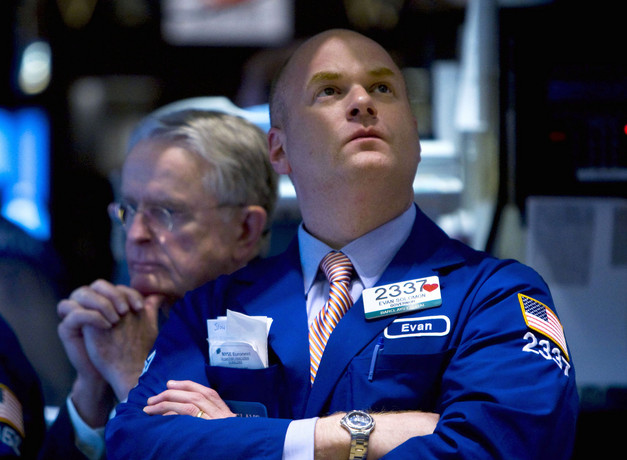
Dow down 7.9% in May; Worst Since 1940

May 28 (Bloomberg) -- REPORTING: U.S. stocks slid, capping the worst May for the Dow Jones Industrial Average since 1940, while the euro slumped and Treasuries rose as a downgrade of Spain’s debt rating and escalating tensions on the Korean peninsula triggered a flight from riskier assets.


Today the Dow tumbled 122.36 points, that's 1.2 percent, to 10,136.63 at 4 p.m. in New York and lost 7.9 percent this month. The Standard & Poor’s 500 Index sank 1.2 percent to 1,089.41, led by financial shares on the Spanish downgrade and energy companies after U.S. President Barack Obama extended a moratorium on new deep-water drilling. Oil erased gains after rallying as much as 1.6 percent to more than $75 a barrel. Ten-year Treasury yields decreased 7 basis points to 3.3 percent. The euro slipped 0.7 percent to $1.2273.


Equities and commodities extended losses after Fitch Ratings stripped Spain of the AAA rating it’s held since 2003, saying the nation’s economic growth will slow as it attempts to cut its debts. Earlier losses followed disappointing U.S. economic data and a North Korean general’s warning of “all-out war” if any accidental clashes with South Korea break out.


“Spain’s downgrade just adds to more uncertainty,” said Quincy Krosby, chief market strategist for Newark, New Jersey- based Prudential Financial Inc., which oversees about $667 billion. “There are too many geopolitical events. We have a three-day weekend in the U.S., and traders will definitely want to lighten their books.”


‘All-Out War’

Losses in U.S. stocks widened earlier after North Korean Major General Pak Rim Su disputed the results of the international investigation that found his nation sank a South Korean warship. “Any accidental clash that may break out in the waters of the West Sea of Korea or in areas along the Demilitarized Zone will lead to all-out war,” he said, according to North Korea’s official news organization.


About 9.2 billion shares changed hands on all U.S. exchanges, 4 percent below the average for the year as trading slowed before the Memorial Day holiday.


“With volumes being as they are today ahead of the holiday weekend, there is not much in the way of conviction among traders,” said Mark Turner, head of U.S. sales trading at Instinet LLC, which handles about 4 percent of U.S. equity trading volume. “So any headline has the potential to move the market. And the situation in North Korea has especially been in our crosshairs.”


China’s Assurance

The retreat in the S&P 500 today came after the benchmark index rallied 3.3 percent yesterday as China assured investors it was committed to maintaining European investments even as a sovereign debt crisis rattles confidence in the region.


Benchmark indexes pared declines late in the day after Goldman Sachs Group Inc. strategist David Kostin raised his estimates for S&P 500 earnings to $78 a share for this year and $93 a share for 2011, up from $76 and $90, to reflect “strong” first quarter earnings and better-than-estimated profit margins.


The S&P 500 trimmed its advance for the week to 0.2 percent, while the MSCI World Index of shares in 24 developed nations rose 0.6 percent over the past five days. The U.S. gauge sank 8.2 percent in May and the global gauge lost 9.9 percent, the worst month since February 2009 for both and the biggest slide in May for the S&P 500 since 1962.


The Stoxx Europe 600 Index erased gains, dropping 0.3 percent today after rallying as much as 0.7 percent. The MSCI Asia Pacific Index climbed 1.5 percent.


Golf Balls, Scraps

BP Plc slid 5 percent in London after Europe’s second- largest oil company said procedures to plug a leaking well in the Gulf of Mexico may last another day or two. BP added rubber golf balls and scraps to the mud it was pumping into its leaking Gulf of Mexico oil well in an effort to stop the spill.

Baker Hughes Inc., Halliburton Co., Transocean Ltd. and Schlumberger Ltd. slumped at least 4.9 percent to help lead declines in U.S. energy shares.


Obama is suspending exploration in two areas off Alaska, canceling pending lease sales in the Gulf of Mexico and proposed sales off Virginia’s coast, extending by six months a moratorium on deepwater drilling permits and suspending operations at all 33 exploratory wells being drilled in the Gulf.


The gain in Treasuries extended the drop in 10-year yields this month to 36 basis points, the biggest monthly loss since December 2008, as government data showed consumer spending in the U.S. unexpectedly stalled, fueling speculation the economic recovery will be slow.

Lowest Since 2009


The benchmark note yield touched 3.06 percent on May 25, the lowest level since April 29, 2009. Its 17 basis point gain yesterday was the most since June.

A gauge of U.S. corporate credit risk climbed the most in 15 months in May as Europe’s sovereign debt crisis sparked concern that economic growth may slow, making it harder for companies to refinance.


The Markit CDX North America Investment Grade Index Series 14, which investors use to hedge against losses on corporate debt or to speculate on creditworthiness, increased 1.34 basis points today and 25.2 basis points this month to a mid-price of 117.17 basis points as of 4:19 p.m. in New York, according to Markit Group Ltd. The index, which typically falls as investor confidence improves and rises as it deteriorates, climbed the most since February 2009, according to CMA DataVision.


Credit markets faltered in May as corporate bond sales fell to the least in a decade amid speculation Greece and other nations in Europe won’t be able to meet their debt payments and as the dispute between North Korea and South Korea raised the risk of a broader conflict.


Crude oil for July delivery fell 58 cents, or 0.8 percent, to settle at $73.97 a barrel on the New York Mercantile Exchange. Oil’s 14 percent decline in May was the biggest monthly decrease since December 2008, when prices touched $32.40 a barrel.


Copper for July delivery lost 1.7 percent to $3.1045 a pound in New York. Gold futures rose in New York, capping a second straight monthly gain, on demand for an alternative to holding the euro. Gold for August delivery climbed 60 cents to $1,215 an ounce in New York.


To contact the reporters on this story: Rita Nazareth in New York at rnazareth@bloomberg.net; Elizabeth Stanton in New York at estanton@bloomberg.net.

Last Updated: May 28, 2010 16:48 EDT